Christmas Lighting
How Much Does It Cost to Install 200 ft of Christmas Lights?
New Age Lights • September 2026 • TN • AL • OH • 8 min read
Google shows the same People Also Ask question in Huntsville, Birmingham, Chattanooga, Knoxville and Cincinnati: how much to install 200 ft of Christmas lights? It is a good question because 200 feet is a real number. It is close to what a typical single-story front actually measures, and it is the figure most homeowners have in their head when they call us in September.
This post walks through the math honestly. We use typical industry ranges rather than our own price list, because our price list does not exist until we have stood in your driveway. Then we explain what those 200 feet actually cover, what moves the per-foot number, and how the lease-versus-buy decision changes the answer over three seasons.
Where the per-foot number comes from
Almost every reputable installer in the Southeast and Midwest prices seasonal lighting by the linear foot of roofline, with add-ons for trees, wreaths, garland and ground features. Across the industry, all-inclusive programs cluster between about $2.50 and $8 per linear foot. That is a wide band, and the spread is not random.
- The low end is usually a re-hang of lights you already own, or a bare-bones price that excludes takedown, storage or mid-season service.
- The middle is a turnkey lease: design, commercial-grade C9 LED bulbs on custom-cut runs, installation, in-season service, takedown and offsite storage, all in one number.
- The high end reflects tall or steep rooflines, difficult access, premium product, or a first-year buy program where you are purchasing the lights outright.
The two other figures worth keeping in mind: basic roofline-only fronts typically land in the $700 to $1,500 range, and full displays with roofline, trees, wreaths and ridge lines run $2,000 to $5,000 and up. A 200-foot job sits squarely in the first bucket.
How much to install 200 ft of Christmas lights?
Take the typical range and do the arithmetic.
| Per-foot rate | 200 ft total | What that price usually means |
|---|---|---|
| $2.50 | $500 | Re-hang of customer-owned lights, or install only with no service, takedown or storage |
| $4.00 | $800 | Turnkey lease on a single-story home with easy access |
| $5.50 | $1,100 | Turnkey lease on a two-story or steep roofline, full service included |
| $8.00 | $1,600 | Tall or complex roofline, lift access, or year-one purchase of commercial-grade product |
So the honest answer to the question is about $700 to $1,500 for a typical home, and the position inside that range is decided by three things: what is included, how high the roof is, and whether you are leasing or buying. A quote of $400 for 200 feet is not a bargain. It is a different product, and the missing pieces show up in December when a strand goes dark and nobody comes.
What 200 feet actually covers
Homeowners tend to overestimate what 200 feet buys. Here is how it typically maps onto the housing we work on across our five metros.
One-story homes
A ranch or single-story brick home with a 60 to 70 foot street frontage usually has 120 to 180 feet of visible eave once you follow the roofline around the garage and any front gable. Two hundred feet covers the full front and often wraps one side. This describes a great deal of the housing in places like Powell and Karns outside Knoxville, or the older ranch neighborhoods around Norwood in Cincinnati.
Two-story homes
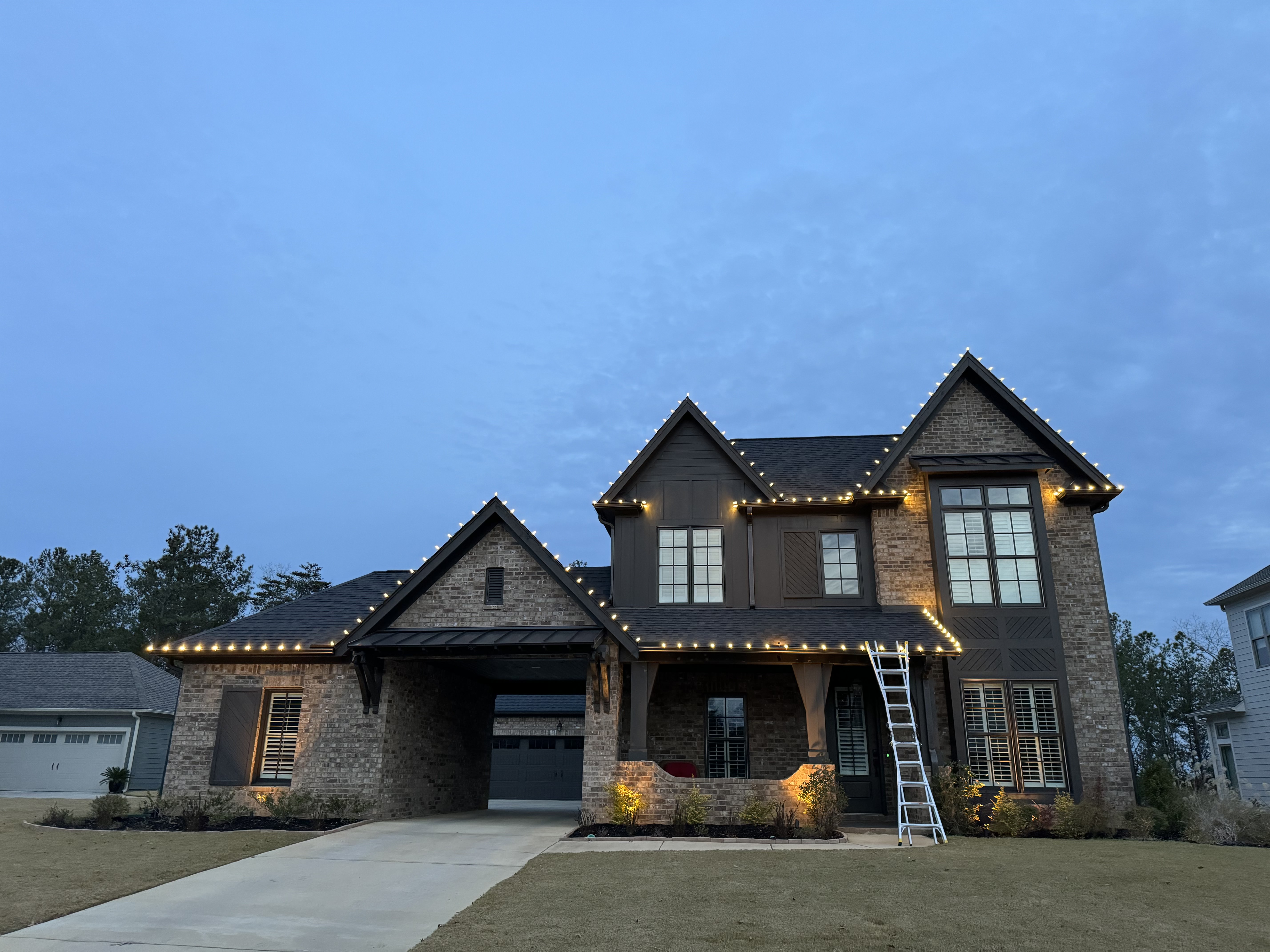
On a two-story with a single front gable, 200 feet covers the main eave line, the gable edges and the garage return. It does not cover a full perimeter, and it does not cover dormers or a second gable. The newer two-story stock in Farragut and Hardin Valley, in Madison outside Huntsville, or in Mason north of Cincinnati often measures 250 to 350 feet for a complete front-plus-sides outline. That is why the same neighborhood can produce quotes of $900 and $1,800 on homes that look similar from the road.
What is not in the 200 feet
Ridge lines, column wraps, window outlines, wreaths, garland and tree wraps are separate line items on almost every installer's quote. If you picture your neighbor's house with the ridge lit and two wrapped trees in the yard, that is not a 200-foot job even if the roofline is exactly 200 feet.
What pushes the per-foot number up or down
Once you understand the drivers, the spread in quotes stops looking arbitrary.
- Height and pitch. A steep two-story roof takes longer and needs different equipment than a walkable ranch. Crews work slower and safer, and the price reflects it.
- Access. Mature trees against the eave, a sloped lot, a roofline over a screened porch or a pool cage all add time.
- Product grade. Commercial-grade C9 LED bulbs on custom-cut runs cost more than retail strings and last many seasons longer. This is the single biggest quality difference between quotes.
- Fixings. Clips matched to your shingle, gutter or fascia profile cost more and take longer than staples. They also do not put holes in your roofing.
- Service. Turnkey programs typically promise a 24 to 48 hour in-season response if a run drops out. That coverage is priced in.
- Takedown and storage. Removal in January and labeled offsite storage are part of a full program and add real labor.
- Booking date. Installers fill their calendars from September onward. A November caller pays the same rate but competes for fewer slots. Our post on why the calendar fills early covers the scheduling side.
Lease versus buy on a 200-foot roofline
This is the decision that changes the three-year cost more than any per-foot haggling. Under a lease, the installer owns the lights and you pay a seasonal fee that covers everything. Under a buy program, you purchase the commercial-grade product in year one and then pay for labor in later years.
| Lease (all-inclusive) | Buy (you own the lights) | |
|---|---|---|
| Year one | Lower. You are not buying product. | Higher. Product plus install. |
| Renewal years | Lower than year one, since design and cut runs already exist. | Labor for install, service, takedown and storage only. |
| Failed strands | Replaced by the installer at no charge. | Your cost, unless covered by a product warranty. |
| Changing the design | Easy. New runs are the installer's problem. | You may need to buy more product. |
| Typical crossover | Buying usually starts to pay off in year two or three, assuming you keep the same design and the product holds up. | |
For a 200-foot roofline that you plan to light for five or more seasons without changing much, buying can come out ahead. For anyone who might move, redesign, or simply does not want to think about it, the lease is the simpler product. We put the numbers side by side at the site visit, and we go deeper in Christmas light installation cost per foot: lease vs buy, explained.
What turnkey actually includes
When we quote a seasonal install, the number covers the entire season, not just the day the lights go up. Our Christmas light installation program includes:
- A free on-site design consult and a fixed quote before anything is ordered
- Commercial-grade LED product, custom-cut to your roofline, not big-box strings
- Clips matched to your shingle, gutter or fascia, with no nails or staples through roofing
- Installation by an insured crew, with timers set so you never touch a plug
- In-season service visits if a run goes out
- Takedown after the holidays and labeled offsite storage
Every one of those items has a cost, and every one of them is what separates a $1,100 program from a $500 hang-and-leave.
Add-ons that turn 200 feet into a full display
If the roofline is the frame, these are the picture. None of them are included in a per-foot roofline price, and together they are what move a home from the $700 to $1,500 range into the $2,000 to $5,000 range.
- Ridge lines. Running lights along the peak of the roof adds footage in the hardest place to reach. It has the biggest visual payoff on tall two-story homes.
- Wreaths and garland. Lit wreaths over the garage or on gable peaks, and garland along a porch rail, are priced per piece.
- Tree wraps. Trunk and branch wraps on yard trees are priced by the tree and depend heavily on size.
- Columns, windows and walkways. Priced by the foot or the piece, usually cheaper per unit than roofline work because access is easy.
Our advice is usually to get the roofline right first. A clean, evenly spaced C9 roofline on 200 feet looks better than a cluttered display where the roofline was an afterthought.
Renewal-year pricing
The question most callers forget to ask is what year two costs. On a lease program, renewal years are priced below year one. The design is already agreed, the runs are already cut and labeled to your house, and the crew is re-hanging a known layout. A homeowner who spends around $1,100 in year one on a 200-foot roofline should expect a noticeably lower renewal, and should ask any installer to put that renewal number in writing before signing.
On a buy program the year-two drop is steeper because you are paying labor only, but you carry the product risk. If a run fails on your own lights, you replace it.
Frequently asked questions
How much to install 200 ft of Christmas lights?
Using typical industry pricing of $2.50 to $8 per linear foot for an all-inclusive program, 200 feet of professionally installed roofline lighting runs about $500 to $1,600, and most homes land in the $700 to $1,500 range once product grade, roof height and service are accounted for. Renewal years on a lease program cost less than year one.
How much should I pay someone to put up Christmas lights?
For a turnkey program that includes design, commercial-grade lights, installation, in-season service, takedown and storage, expect roughly $700 to $1,500 for a basic roofline-only front and $2,000 to $5,000 or more for a full display with trees, wreaths and ridge lines. A quote much lower than that usually leaves something out.
Does 200 feet cover a whole house?
It covers the street-facing roofline of most one-story homes and the main eave and gable lines of a modest two-story. A full perimeter, a second story with dormers, or a wraparound porch will push the footage higher, which is why we measure on site rather than guess from the curb.
Is it cheaper to lease or buy Christmas lights?
Year one is usually cheaper on a lease because you are not buying the product. Buying costs more up front and then drops to labor-only in later years, so the crossover is typically year two or three. Leasing also means the installer replaces failed strands at no extra charge, which matters more than the math suggests.
Why is year two cheaper on a lease program?
Because the design work is done, the runs are already custom-cut and labeled to your house, and the installer is re-hanging a known layout rather than building one. Most programs price renewal years below year one for exactly that reason.
When does New Age Lights give a firm price?
After a free on-site visit. We measure the actual roofline, look at height and access, agree the design with you and hand over a fixed quote before anything is ordered. That number is the number.
Get a fixed price for your roofline, not a per-foot guess
New Age Lights has completed more than 3,000 lighting projects across Tennessee, Alabama and Ohio. We measure your home, show you the design, and give you one number that covers the whole season. If your home suits permanent lighting better, we will tell you that too and walk you through JellyFish and Bosso; both manufacturers publish their specifications at jellyfishlighting.com and bosso.biz.
Get a free quote or call your local office:
- Huntsville, AL: (256) 530-0754
- Birmingham, AL: (205) 382-8991
- Chattanooga, TN: (423) 528-1240
- Knoxville, TN: (865) 264-0180
- Cincinnati, OH: (513) 713-0490