Newage Lights • July 2026 • Serving TN, AL & OH
Short Answer: The week after July 4 is the biggest inbound call window of our summer. Homeowners across Knoxville, Nashville, Huntsville, Birmingham, Columbus, and Cincinnati spent the holiday weekend at backyard cookouts watching neighbors run red, white, and blue patterns on their rooflines. They saw the system in person, asked how it worked, and now want one before football season starts in late August. If you fall into that group, the install math is simple. Most residential permanent lighting jobs take 2 to 4 weeks from contract to completion. Booking in July puts you on a roofline before kickoff. Waiting until October puts you behind the holiday rush and likely into 2027 for installation.
If you watched a neighbor run a programmed light show on July 4 weekend and now you are wondering what it would cost to put one on your own house. You are not alone. The week between July 5 and July 15 is the busiest call window of our summer at Newage Lights. We get more inbound consultation requests during that stretch than any other ten day period of the year except the week after Thanksgiving.
The pattern is consistent across our entire service area. A homeowner in Brentwood, Madison, Vestavia Hills, or Dublin attends a Fourth of July gathering, sees a permanent lighting system in operation for the first time, and realizes that what they had pictured as either tacky novelty lights or hardwired commercial signage is actually a discreet architectural product that disappears during the day. The conversation usually starts the same way. "I had no idea that was a permanent install. I thought he put it up for the holiday."
We want to walk through what that homeowner needs to know now, including why July is a smart install month, what the next six months of use cases actually look like, and the realistic cost picture for a residential install across our Tennessee, Alabama, and Ohio markets.
Why the Post-July 4 Window Drives So Many Calls
Three things converge in that first week of July to drive interest.
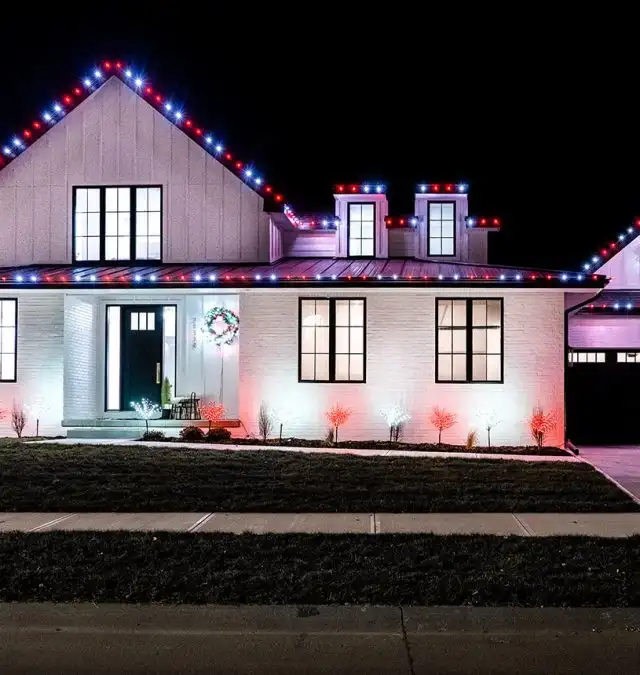
First, modern permanent lighting systems have reached the visual quality that they hold up in side-by-side comparison with traditional holiday lighting. A red, white, and blue chase pattern running across a 90 foot front roofline looks intentional and refined rather than gimmicky. The pixel density on current generation systems (one LED point every 4 to 6 inches) produces smooth color transitions rather than the dotted-line look of earlier products.
Second, the addressable color technology that lets each LED point change independently is the same technology used in stadium video boards and concert lighting. Homeowners who attend a college football game, a concert at Ascend Amphitheater in Nashville, or a Predators or Blue Jackets game at Bridgestone or Nationwide Arena see this lighting at scale. When they see the same effect on a neighbor's house, the connection clicks. The product is now familiar.
Third, the price has come down. A residential permanent lighting install that cost $12,000 to $18,000 in 2018 typically runs $4,000 to $9,000 today for the same linear footage. The reduction is partly LED component costs falling, partly more installers competing in each market, and partly streamlined installation methods that take crews two days instead of four.
The Install Timeline From a July Call
For a homeowner calling us in the second week of July, the typical sequence runs as follows.
Week 1: initial consultation. We schedule a site visit within 5 to 10 business days for most addresses across our service area. The site visit takes 45 to 90 minutes and covers a linear footage measurement of the rooflines you want lit, a review of any architectural features you want highlighted (gables, dormers, columns, soffit returns), an inspection of fascia condition, identification of the outlet that will power the system, and a discussion of control preferences.
Week 2: design and proposal. We send a written proposal within 3 to 5 business days of the site visit. The proposal includes a design rendering, a fixed price for materials and labor, a warranty term, and proposed install dates.
Week 3 to 4: install. Most residential jobs are scheduled within 2 to 3 weeks of contract signing. The install itself takes one to two days for a typical residence. Larger homes with multiple stories or detached structures (garages, pool houses, gazebos) may run two to three days. The crew handles the entire job from track installation to fixture mounting to controller programming to homeowner walkthrough on the final day.
For a homeowner who calls on July 8, the realistic completion date is the first week of August. That puts the system fully operational well before the first SEC, Big Ten, or ACC kickoff weekend in late August.
The Use Cases That Carry the System Through Year One
For homeowners who buy because they saw a July 4 display, we want to be honest about what the first twelve months of ownership actually look like.
Late summer entertaining (August through early September)
Backyard cookouts, pool parties, and patio gatherings benefit from soft warm white at 2700K to 3000K across the roofline and accent lighting on architectural features. The system replaces the awkward dark transition that happens when a backyard gathering moves from afternoon into evening.
Football season (late August through January)
For homes in our service area, the team color presets carry a remarkable amount of the use during fall. Tennessee orange and white. Alabama crimson and white. Auburn orange and navy. Ohio State scarlet and gray. Cincinnati red and black. Tennessee Titans navy and light blue. Most controllers ship with college and pro team presets already loaded. Game day Saturdays become a meaningful part of how the system gets used.
Halloween (October)
Orange and purple with a slow fade animation. A flicker effect across portions of the roofline to suggest candlelight. Static spider web patterns on gables. The customization options for Halloween are extensive and the system gets daily use across the month.
Veterans Day and Memorial Day (November and May)
Static red, white, and blue with no animation reads as respectful rather than celebratory. The same color combination programmed differently from July 4.
Thanksgiving (late November)
Warm amber and burnt orange tones extend the autumn entertaining season. Many homeowners run the system from sunset to 10pm across the Thanksgiving week for arriving family.
Christmas and the December holidays (December)
This is the heaviest use month of the year for almost every system we install. Traditional red and green static. Animated chase patterns. Multicolor with twinkle effects. Some homeowners run different programs each night of the week. The system replaces what used to be $1,200 to $2,200 per year in professional holiday light installation and takedown.
New Year, Valentine's, St Patrick's, Easter, Mother's Day, Father's Day, graduations, birthdays, anniversaries
The minor holidays and personal events add up. Most owners run their system on roughly 180 to 220 nights per year by the end of year one.
What a Realistic Cost Looks Like in Our Service Area
For a home with 90 to 130 linear feet of front roofline (typical for a single story or two story home in subdivisions across Knoxville, Nashville, Huntsville, Birmingham, Columbus, and Cincinnati), installed cost runs $4,200 to $6,800 for a front-only install with standard pixel density.
For a home with 160 to 220 linear feet covering front and both sides plus a garage, installed cost runs $6,500 to $9,500.
Larger homes with detached structures, multiple gables, columns, or pool area lighting can run $10,000 to $18,000. Estates with full architectural lighting and multiple outbuildings can run $20,000 to $40,000.
The price ranges reflect three variables. Linear footage drives most of the cost. Pixel density (one LED every 3 inches versus every 6 inches) is the second largest factor. Architectural complexity (number of corners, gables, and direction changes the track has to follow) is the third. Custom controller setup, smart home integration, and music sync features add modest amounts on top.
What Football Season Use Looks Like in Practice
For homeowners across Tennessee, Alabama, and Ohio, college football is one of the most consistent use patterns we see. Here is what a typical fall Saturday looks like for a home with the system.
Friday evening. Owner pulls out the phone, taps the team preset, and the roofline runs school colors from sunset through the end of the evening. Neighbors driving home from work see it.
Saturday morning. Same colors run during tailgates and pre-game gatherings. For homeowners hosting tailgate parties, the system stays on through the early afternoon.
Saturday game time. Some owners switch to an animated chase pattern in team colors during the game broadcast itself. Others leave the static colors running.
Saturday evening after a win. A celebration animation. Some controllers have built-in fireworks or burst patterns specific to the moment.
Sunday. Back to warm white or off until next weekend.
For homes that host more than three or four game day gatherings per fall, the system becomes a feature of the entertaining setup the same way a patio or grill area does.
What Slows a July Install
Most July installs proceed without complications. The few that take longer than the 2 to 4 week window do so for predictable reasons.
Fascia repair. If the rotted or damaged fascia is discovered during the site visit, we recommend the homeowner address it before install. This adds time depending on the contractor and the extent of repair.
Electrical work. Some older homes lack a serviceable outdoor outlet. Running a new exterior outlet on a dedicated circuit adds a half day of licensed electrician work and possibly a permit depending on the municipality.
Roof age. For homes within a few years of a roof replacement, we sometimes recommend waiting and coordinating the lighting install with the new roof. The track and fascia bracket detail is cleaner on new construction or a recent reroof.
HOA approval. A handful of subdivisions across our service area require architectural committee approval for permanent exterior lighting. The approval process adds one to four weeks depending on the HOA meeting schedule. We can provide product brochures and renderings to support the application.
Why Waiting Past August Tightens the Schedule
Our scheduling capacity in our markets shifts dramatically after Labor Day. By mid September we are typically booked four to six weeks out. By early October the lead time stretches to eight to ten weeks. By Halloween any homeowner who has not yet booked is realistically looking at a January or February 2027 install, which means missing the entire holiday season they were planning to use the system for.
For homeowners who saw a system on July 4 and want to be running their own by Christmas, the booking decision needs to happen by mid August at the latest. Calling us in July gives you a comfortable buffer.
Frequently Asked Questions
Is permanent lighting really invisible during the day?
The track sits in the gutter line shadow and the individual LED points are 5/8 inch in diameter. From the curb the system is visually negligible. From directly under the eave looking up you can see the track, but no one stands there looking up at a roofline during the day.
What is the warranty on a typical system?
Our installations carry a 5 year warranty on the LED components and track, with the labor warranty on installation defects covered for the life of the system. Specific terms are in the written proposal.
Does the system work with Alexa, Google, or HomeKit?
Most current controllers integrate with Alexa and Google Assistant for on, off, and basic scene selection. HomeKit support varies by manufacturer. We confirm specific compatibility during the consultation.
What happens if a single LED point fails?
Individual LED points are field replaceable. A warranty service call replaces the affected fixture and recalibrates the controller. Most failures we see are isolated to one or two fixtures over a five year window.
What to Do Next
If you watched a neighbor's permanent lighting over July 4 weekend and want a system on your own home before football season starts, the right move is scheduling a consultation in the next two weeks. We will measure your linear footage, review the architectural features you want highlighted, send a written proposal with a fixed price, and have you installed in time for the first game weekend.
Call us at 256-530-0754 or visit newagelights.com to schedule a consultation. We serve homes across Tennessee, Alabama, and Ohio from our Huntsville office.