Newage Lights • July 2026 • Serving TN, AL & OH
Permanent Outdoor Lighting for Late-Summer Entertaining
How to Design for Patios, Pools, and Backyards
Designing permanent outdoor lighting for entertaining is about layered zones rather than maximum brightness. A system that handles all three zones independently from one app, with separate dimming and color control, is what creates the designed feel rather than the lit-up feel.
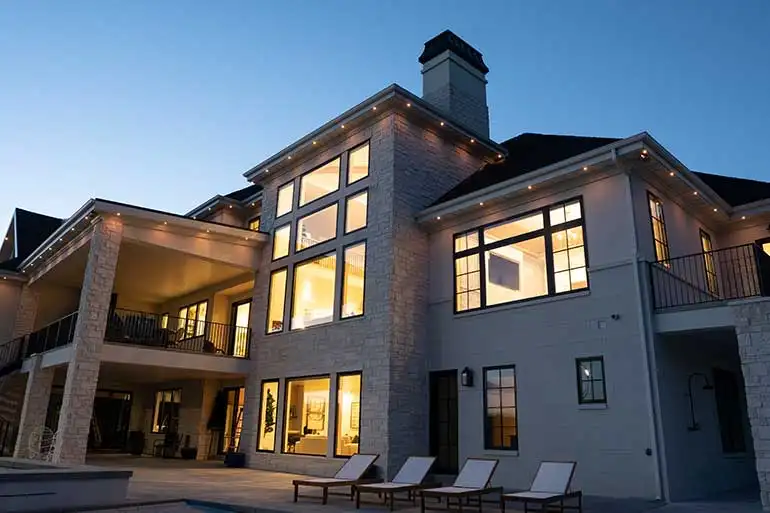
Permanent outdoor lighting is no longer just a roofline product. The category has expanded to include patio overhead lighting, pool coping accents, downlight wash from soffit-mounted fixtures, uplighting on trees and architectural features, and integrated path lighting along walkways. A well-designed entertaining yard uses all of these in layered zones rather than relying on a single bright light source.
We have designed and installed enough late-summer entertaining setups across Knoxville, Nashville, Huntsville, Birmingham, Columbus, and Cincinnati to know which design choices change how a backyard actually feels at night, and which ones look impressive in a brochure but disappoint in person.
The Zoning Concept
The single most important design decision is treating different areas of the yard as independent lighting zones with separate control. A poorly designed system runs everything at one brightness level on a single switch. A well-designed system lets the homeowner dim the patio to 30 percent while leaving the pool perimeter at 60 percent and the tree uplights at 80 percent.
Patio Zone
Warm overhead wash optimized for conversation and dining, set between 25–40% brightness for an intimate atmosphere.
Pool Zone
Cool accent coping lights plus deck downlights provide safe visibility while letting the water reflect light dramatically.
Backyard Zone
Layered accent lighting, path lights, feature uplights, and property line accents, defines the outdoor room.
8–16 Independent Zones
Most current-generation controllers support 8 to 16 zones from a single panel, each addressed independently in the app.
Designing the Patio Zone
Color Temperature
Use 2700K–3000K warm white as the base. This matches the warmth of incandescent lighting. Cooler temperatures (4000K+) read as commercial or clinical and undercut the entertaining atmosphere.
Brightness Target
Aim for 2–5 footcandles on the patio surface for relaxed entertaining. Lower than most homeowners expect, brightness above that range washes out faces and conversations.
Fixture Placement
Overhead wash from the soffit projects light down onto the surface. Keep the light source above eye level and behind seated guests. Avoid direct light into seating areas.
Pergola Integration
Integrate 24V DC linear LED strips at 2700K into pergola rafters for excellent ambient light. Safe to touch and easy to pair with permanent system controllers.
Designing the Pool Zone
Pool areas need a different approach because the water reflects and amplifies light. Permanent lighting around the pool perimeter is where we work, not inside the pool itself.
Coping Accent
Fixtures (0.5W–1W per LED point at 12V DC) mounted along the underside of pool coping create a subtle deck wash that doubles the perceived size of the pool at night.
Deck Downlights
One downlight (8W–15W) every 6–8 feet along the soffit above the pool deck. Brightness target: 5–10 footcandles for safe walking while still allowing dramatic water reflection.
Color & Music Sync
Slow color fades, static deep blue, or synchronized animations for parties. The pool is also where music sync earns its keep, the water surface amplifies the effect.
Electrical Safety
All fixtures within 10 feet of a pool waterline require GFCI-protected circuits per NEC. Our 12V/24V DC fixtures are inherently safer than line voltage, but the transformer still requires GFCI upstream.
Designing the Backyard Zone
The backyard zone covers everything beyond the patio and pool. The right design framework is layered accent rather than uniform wash.
Path Lighting
Path lights every 6–10 feet along walkways from patio to pool, back door to fire pit, and around garden paths. 3W–6W at 12V LED, matched to patio zone at 2700K–3000K.
Feature Uplights
Select 2–3 visual anchors: a mature oak, a Japanese maple, a limestone retaining wall, or a feature boulder. Uplight fixtures (5W–20W at 12V) mount at the base pointing up into the canopy or against the wall.
Avoiding Overlighting
A backyard with 8 accent fixtures often feels worse than the same backyard with 3. Restraint is the design choice that separates a designed yard from a lit yard. Dark space makes lit features stand out.
Avoiding Light Trespass
Do not aim accent fixtures across property lines. Use shielded fixtures with adjustable shrouds. Aim them carefully so spill light stays on your property.
The Roofline Connection
For homes with existing permanent roofline lighting, the entertaining zones should integrate with the roofline on the same controller. A single tap in the app sets the entire backyard for entertaining mode. A different tap sets it for a romantic dinner. Another sets it for kids in the pool. The system becomes programmable mood lighting for the entire outdoor space.
For homes without existing roofline lighting, we recommend installing the roofline first and adding entertaining zones in phase two. The roofline establishes the controller, the outdoor outlet, and the system backbone. Additional zones connect to that backbone over the next year or two as budget allows.
Three Design Mistakes to Avoid
Mistake 1: Too Bright
Homeowners reach for the highest wattage fixtures, install too many, and end up with a yard that feels like a parking lot. The fix is zone-level dimming, set each zone at 25–50% and the same fixtures go from harsh to intimate.
Mistake 2: Wrong Color Temperature
Mixing 5000K daylight LEDs with 2700K warm LEDs in the same yard creates a visual mismatch the eye reads as wrong. Standardize on 2700K–3000K for entertaining areas and reserve color shifts for accent moments.
Mistake 3: Uniform Coverage
Lighting every square foot evenly produces a flat, uninteresting result. Lighting designed to highlight 3–4 features against darker surroundings produces depth and visual interest. The dark space is what makes the lit features stand out.
Voltage, Wattage & Operating Cost
The electrical commitment is smaller than most homeowners expect.
12V / 24V DC
System voltage stepped down by a transformer from 120V AC. Fixtures are safe to touch when energized.
200W–600W
Total system wattage at maximum output for a typical residential install including roofline plus accent zones.
~$5–$7/month
At 400W for 4 hours per evening across our service area's electricity rates of 10–14 cents per kWh. Essentially free to operate.
1 Circuit
A dedicated 15A or 20A circuit for the transformer near the controller cabinet. Typically $200–$500 for an electrician to add during installation.
Ready to Design Your Entertaining Space?
We serve homeowners across Knoxville, Nashville, Huntsville, Birmingham, Columbus, and Cincinnati. Our team will walk you through a zone-by-zone design tailored to your patio, pool, and backyard, and every system installs permanently so you never think about it again.