Newage Lights • July 2026 • Serving TN, AL & OH
Short Answer: SEC, Big Ten, and ACC kickoff weekends fall on August 29 and September 5 in 2026. To have permanent outdoor lighting installed and programmed for the first game weekend, the realistic booking deadline is the first week of August. Our typical install lead time from contract to completion is 2 to 4 weeks. Team-color presets for Tennessee, Alabama, Auburn, Ohio State, Cincinnati, the Titans, the Browns, and the Bengals come pre-loaded on most current controllers. A game-day setup takes about ten minutes once installed: select team preset, choose static or animated mode, set the run time. The system replaces hand-strung holiday lights, lawn flags, and the annual debate about how to show team spirit without looking tacky.
If you live in our service area, the football calendar dictates a meaningful portion of your social schedule from late August through early January. Tennessee Vols home games at Neyland. Alabama and Auburn on alternating Saturdays. Ohio State at the Horseshoe. Cincinnati Bearcats and Bengals. Tennessee Titans, Cleveland Browns. For a substantial percentage of homes across Knoxville, Nashville, Chattanooga, Huntsville, Birmingham, Tuscaloosa, Columbus, Cincinnati, Dayton, and Cleveland, game weekends are when entertaining peaks.
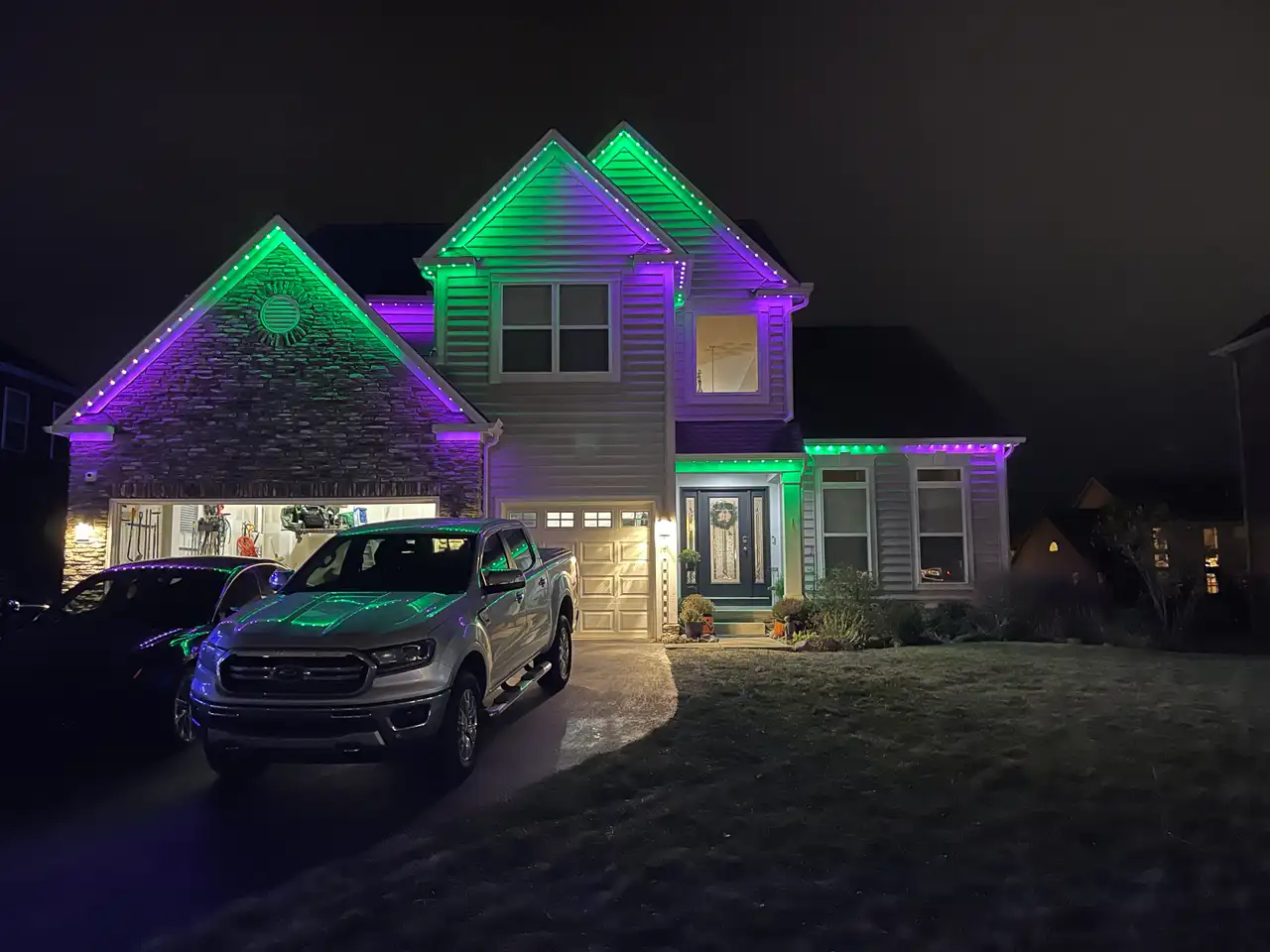
Permanent outdoor lighting changes how a home shows team spirit on those weekends. Instead of a flag in the yard or string lights in school colors that have to come down each Sunday, the entire roofline runs team colors at the tap of a phone. Static colors for tailgates. Animated chase patterns during the game. Celebration animations after a win. The system goes back to warm white on Sunday morning and nobody had to climb a ladder.
For homeowners considering this category, July is the install window. We want to walk through the timing, the team-color setup, the game day workflow that actually plays out, and what a realistic install for a football-focused homeowner looks like.
The 2026 Football Calendar and the Install Math
College football week zero falls on August 22 in 2026. Week one is August 29. The full slate of SEC, Big Ten, and ACC openers runs the weekend of September 5. NFL preseason begins August 8 with Week 1 of the regular season on September 10.
Our typical install timeline runs 2 to 4 weeks from contract signing to completed install. A homeowner who calls us during the first week of July can comfortably be installed and programmed by early August. A homeowner who calls in mid August is tight on the September 5 weekend and likely will not be operational until late September.
For 2026, the recommended booking deadline to guarantee operation by Week 1 is August 5. The recommended deadline to guarantee operation by Week 2 (September 12) is August 19. Beyond that we get into late-September installs, and the homeowner misses three to four weeks of game days they were hoping to enjoy the system through.
Team Color Presets and What They Actually Look Like
The most common question we get from football-focused homeowners is whether the team colors look right or whether they come out as a generic approximation. The honest answer is that current generation controllers produce remarkably accurate team colors because the systems run on full RGB color mixing with white channel correction.
Practical examples. Tennessee Vols orange (PMS 151) is reproducible on our systems within a couple shades. Alabama crimson (PMS 201) and Auburn navy (PMS 289) reproduce cleanly. Ohio State scarlet (PMS 200) and gray (PMS 429) split nicely across alternating fixtures. Cincinnati Bearcats red and black. Tennessee Titans navy and Titans blue. Cleveland Browns brown and orange. Cincinnati Bengals orange and black. Each of these comes pre-programmed on the controllers we ship with our installations.
For two-color schools (most of them), the system runs the colors in alternating fixture positions or in larger blocks depending on the look the homeowner prefers. Alternating fixtures produces a finer pattern that reads as visually busy from a distance. Larger color blocks (8 to 12 fixtures of one color, then 8 to 12 of the other) produce a more dramatic look from the street.
For schools with three colors (Ohio State scarlet, gray, and white), the third color typically runs in accent positions like architectural features rather than across the entire roofline.
The Game Day Workflow That Actually Plays Out
For homeowners who buy the system specifically for football, here is what a typical game weekend looks like once installed.
Thursday and Friday evening before a Saturday game
Owner opens the app, taps the team preset, and sets the system to run from sunset to 11pm. Neighbors driving home from work pass the house and see school colors. For homes that host Friday night dinners with friends ahead of the game, the colors set the tone before guests arrive.
Saturday morning during tailgate prep
If hosting a tailgate before the game, the system runs static team colors during cooking and setup. For homes near a college campus that host pre-game gatherings. This is the most visible use of the system during the week.
Saturday game time
Two homeowner styles. Some leave the static colors running throughout. Others switch to an animated chase or wave pattern during the broadcast. Both work. The animated mode is more visible to passing cars but more distracting from the screen.
After a win
Celebration animations are where the system earns its money. A burst pattern that cycles through team colors with high brightness for the first 15 minutes after the final whistle. Some homeowners step outside specifically to enjoy the visual after a big win.
After a loss
Most owners report turning the system to warm white or off until the next game. The system can match mood as well as celebration.
Sunday morning
Warm white at low brightness for arriving guests or daytime ambient. The home returns to normal until the next game day.
NFL Sundays and the Bengals, Browns, and Titans Schedule
For homeowners across our service area who follow the NFL, Sundays have their own pattern. Bengals home games at Paycor Stadium typically draw the Cincinnati and Northern Kentucky audience. Browns games at Huntington Bank Field draw across Northeast Ohio. Titans games at Nissan Stadium in Nashville draw across Middle Tennessee.
The NFL color setup is simpler than college because there is only one local pro team in each market. The Bengals orange and black or the Browns brown and orange or the Titans navy and titans blue come preset on the controller. A single tap sets the system for the NFL Sunday afternoon and into evening.
For homes that host Sunday afternoon watch parties, the system performs similarly to college Saturdays. The visual sets the tone for the gathering before kickoff and provides the celebration mechanism after a win.
What a Football-Focused Install Looks Like
For homeowners installing specifically with football season in mind, the design choices we recommend differ slightly from a homeowner installing primarily for Christmas.
Linear coverage. Full front roofline is the minimum. For homes that host tailgates or watch parties, extending the lighting around to both sides of the house creates a more dramatic effect from the street and the driveway.
Pixel density. Standard 6 inch spacing is fine for static team colors. Homeowners who want smooth animation effects during games benefit from 4 inch spacing because the chase patterns read more cleanly.
Brightness capability. Full brightness output should be at least 50 lumens per LED fixture for game day visibility. Lower output products look fine at night but get washed out by twilight or by streetlights in suburban settings.
Controller scenes. The controller should be set up with team-specific scenes for each team the household follows. A single tap should produce the full team color setup. The homeowner should not have to manually configure colors on every game day.
Music sync option. Some homeowners want the lights synchronized to fight songs or game broadcasts. The music sync feature requires either a microphone module connected to the controller or a Bluetooth audio stream. Discuss this during the consultation if it matters to you.
What Game Day Looks Like in a Neighborhood
One of the dynamics we see across our service area is that game day lighting tends to multiply across neighborhoods. A homeowner installs the system in July. Their first season they run team colors for every home game. By the following spring, two or three other houses on the same street have installed similar systems. By the second football season the entire neighborhood is running team colors on Saturday afternoons.
This is partly a visibility effect (neighbors see the system in operation and decide they want one) and partly social (homes coordinating team colors across a street creates a stronger visual identity for the neighborhood). For homeowners who want to be the first house in their subdivision with the system, July install is the window before that wave of installations starts in the post-Labor Day rush.
For Mixed-Loyalty Households
One of the practical questions football households face is what happens when two adults in the home support different teams. An Alabama graduate and an Auburn graduate. An Ohio State alum married to a Michigan alum. A Tennessee fan married to a Vanderbilt fan.
The system handles this without drama. Each team has its own preset on the controller. Whichever team is playing that day gets the roofline. For the Iron Bowl, the Egg Bowl, the Battle of the Brazos, or the Game (Ohio State versus Michigan), some households split the roofline left side and right side between the two teams during the broadcast. Others alternate the colors fixture by fixture. Whichever team wins, the celebration animation runs in that team's colors only.
For households with kids, several school presets can be loaded so a high school student's team colors can run for their Friday night games. The flexibility is the point.
What the Install Process Looks Like in July
For a homeowner calling in early to mid July, the process runs in three phases.
Phase one. Site visit and consultation. We come to the home within 5 to 10 business days. We measure linear footage, evaluate architectural features, discuss which teams the household follows, identify the outlet location, and discuss zone strategy. Visit takes 45 to 90 minutes.
Phase two. Proposal and contract. We send a written proposal within 3 to 5 business days. The proposal includes a fixed price, a rendering of the lit home, a list of pre-programmed team scenes the system will include, the controller model and specifications, the warranty terms, and proposed install dates.
Phase three. Install and programming. The crew arrives on the scheduled date. Most installations take one day for a front-only install, two days for a wraparound install with multiple zones, three days for larger or more complex homes. On the final day we walk the homeowner through the app, set up the team scenes, save the homeowner's preferred scenes to easy-access positions, and connect the system to the home's WiFi for app control.
From contract signing to lit roofline. 2 to 4 weeks for the typical residential install across our service area.
Warranty, Maintenance, and the Long Run
For football households running the system 12 to 16 game weekends per year for the next decade, total run time builds up.
LED life. Current generation LEDs are rated for 50,000 hours of operation. At 4 hours per game weekend across 16 weekends per year, total annual run time is 64 hours. Even at heavy use of 200 hours per year (factoring in non-game use), the LED rating supports 250 years of operation. The LEDs will outlive the homeowner.
Warranty. Our installations carry a 5 year warranty on LED components and track. Labor warranty on install defects is lifetime.
Maintenance. Permanent lighting requires minimal maintenance. Annual or biennial visual inspection of the track and fixtures for any wind damage or debris. Occasional replacement of individual LED points (we have replaced roughly 2 percent of fixtures across systems in the field over the first 5 years).
Frequently Asked Questions
What if my team's colors are not pre-loaded?
The controller supports custom color creation. We program in any team color combination during install. Smaller colleges, high schools, and youth teams are all supported.
Can the system run different teams on different parts of the house?
Yes. Each zone can run a different color. A common setup is one team on the front roofline and a different team on the back patio for households with split loyalties.
Will the colors look right during the day?
Permanent lighting is designed for night visibility. During daylight the LEDs are visible if you look directly at the fixtures but the visual effect is minimal. The system primarily lives in the evening and night hours.
Does the system have to be on for the entire game?
No. Schedule the system to come on at sunset and turn off at 11pm or midnight. The lights do not need to be on during daytime games. For night games the system covers the broadcast window naturally.
What to Do Next
If you want permanent outdoor lighting running team colors before the first SEC, Big Ten, or ACC kickoff weekend in 2026, the right move is scheduling a consultation in the next two weeks. We will measure your home, set up the team scenes you want, send a written proposal, and have you installed before Week 1.
Call us at 256-530-0754 or visit newagelights.com to schedule a consultation. We serve homes across Tennessee, Alabama, and Ohio.